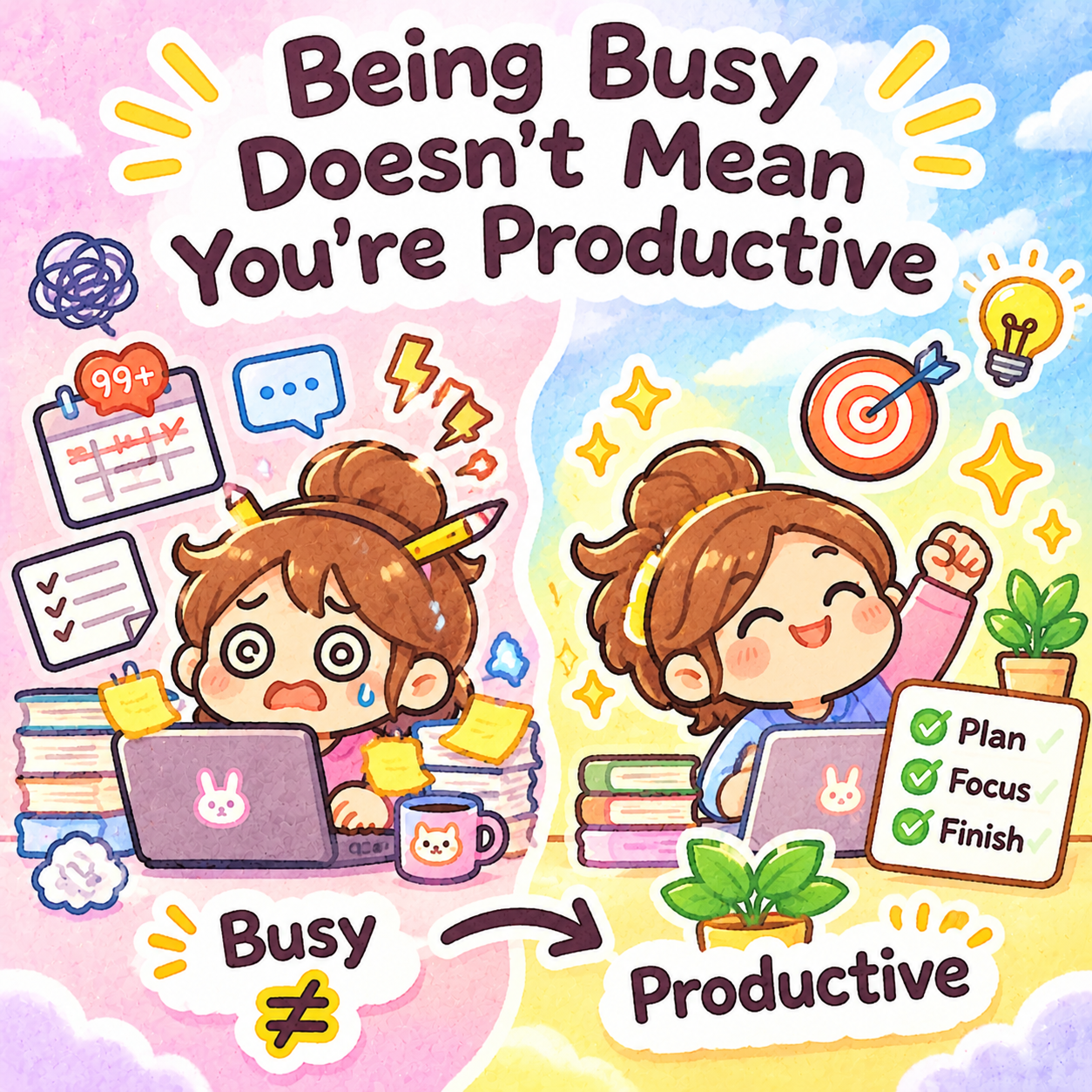
- Being busy means you’re doing things. Being productive means you’re making meaningful progress.
- Constant multitasking can make you feel active while important work remains unfinished.
- Prioritizing results matters more than filling every hour with tasks.
- You don’t necessarily need longer working hours. You need to make your time count.
- Small changes in focus, planning, and boundaries can improve your daily workflow.
The Busy Person Who Never Seems to Finish Anything
Picture this: It’s 9 AM. You’ve already opened your email, checked three work chats, replied to a colleague, updated a spreadsheet, and joined your first meeting. By lunchtime, you’ve handled dozens of little things. You’re moving constantly, switching between tabs, responding to requests, and squeezing in another meeting.
At 5 PM, someone asks what you’ve accomplished today.
You pause.
You know you’ve been working. You haven’t exactly been relaxing. But when you try to name the important things you’ve finished, the list suddenly looks much shorter than expected.
Sound familiar?
This is one of the most frustrating workplace experiences: spending an entire day being busy without feeling genuinely productive. And the tricky part is that being busy can look a lot like being productive.
We often associate productivity with visible activity. A full calendar, a crowded inbox, quick replies, and long working hours can create the impression that we’re getting a lot done. But activity and progress aren’t interchangeable.
Sometimes, the person who finishes three meaningful tasks has contributed more than someone who spends the entire day completing twenty smaller ones.
Being Busy vs. Being Productive: What’s the Difference?
Being busy is about activity. Being productive is about outcomes.
A busy person may spend hours answering messages, attending meetings, organizing files, and switching between responsibilities. A productive person asks which activities actually move their priorities forward.
This doesn’t mean small tasks are useless. Every workplace needs communication, organization, and maintenance. The problem begins when these activities consume so much time that important work receives whatever energy is left.
- The busy approach You respond to whatever appears in front of you. Your priorities change throughout the day, and you measure progress by how many tasks you’ve handled.
- The productive approach You understand what matters most, protect time for important work, and evaluate your day by the outcomes you’ve achieved.
- The balanced approach You handle necessary daily responsibilities while making sure they don’t completely replace meaningful, long-term progress.
5 Reasons You Might Be Busy but Not Productive
1. You’re Constantly Multitasking
You start writing a report, receive a message, check your email, remember another task, and suddenly find yourself researching something completely unrelated.
Your attention is everywhere, but your progress is scattered.
Frequently switching between tasks can make it harder to maintain concentration and complete work that requires sustained attention. Even small interruptions can make it difficult to return to where you left off.
Try this instead: Give important tasks a dedicated period of attention. Decide when to check messages rather than reacting immediately to every notification.
2. You Confuse Urgency with Importance
An incoming message feels urgent. A colleague needs a quick answer. Someone asks you to review a document. Meanwhile, the project you’ve been meaning to finish gets pushed to tomorrow. Again.
Urgent tasks are often more noticeable than important ones. They demand attention right now, while meaningful work may have deadlines that seem far away.
Try this instead: Before starting a task, ask yourself: Does this need to happen now? What happens if I don’t do it today? These questions help separate genuine priorities from distractions.
3. You Spend Too Much Time Preparing to Work
You organize your folders, redesign your task list, update your calendar, research productivity apps, and color-code your entire schedule.
Everything looks beautifully organized. Except the actual project hasn’t moved forward.
Planning is useful, but it can become a comfortable way to delay difficult work. Sometimes organizing feels easier than starting something that requires concentration or decision-making.
Try this instead: Give yourself a reasonable amount of preparation time, then move into action. Your task list doesn’t need to be perfect before you begin.
4. You Say Yes to Almost Everything
A teammate asks for help. Your manager adds another responsibility. Someone needs you in a meeting. You agree because you want to be helpful and don’t want to disappoint anyone.
Before you know it, your schedule belongs to everyone except you.
Being cooperative is valuable, but constantly accepting additional work can leave you with too little time for your own responsibilities.
Try this instead: Before accepting a new task, check your current workload. If necessary, explain what you’re already working on and ask which responsibility should take priority.
5. You Measure Your Effort Instead of Your Results
You’ve worked late, attended every meeting, answered every message, and barely taken a break. Surely that means you’ve had a productive day, right?
Not necessarily.
Effort matters, but hours spent working don’t automatically tell you whether you’ve achieved the intended result.
For example, a marketing team might spend an entire day discussing campaign ideas without choosing a direction or defining the next steps. The discussion may have been useful, but the team still needs a concrete outcome.
Try this instead: Define what done looks like before starting an important task. Instead of writing ‘work on campaign,’ write ‘complete the campaign outline and agree on three test ideas.’
7 Signs You’re Actually Being Productive
- 1. You know your priorities You can identify the most important things you need to accomplish without constantly changing direction.
- 2. You finish what you start Important tasks regularly move toward completion instead of remaining permanently unfinished.
- 3. You make progress on meaningful goals Your daily activities contribute to something larger, whether that’s improving a process, completing a project, or developing a skill.
- 4. You can focus without constant interruptions You create opportunities to concentrate on work that requires deeper thinking.
- 5. You know when to stop You recognize when a task is complete and when additional polishing won’t make a meaningful difference.
- 6. You communicate your progress You can explain what you’ve accomplished, what you’re working on, and where you need support.
- 7. You leave room for improvement You regularly review your approach and adjust your workflow instead of repeating the same inefficient habits.
How to Become More Productive Without Working Longer
1. Choose Three Meaningful Priorities
Instead of creating a list of twenty tasks every morning, identify three outcomes that would make your day feel worthwhile.
For example:
– Finish the first draft of a project proposal. – Review campaign performance and identify the next improvement. – Complete the monthly report and send it to the relevant team.
You can still handle smaller responsibilities, but these three priorities give your day direction.
2. Give Important Work Your Best Attention
Notice when you naturally feel most focused. Some people prefer tackling difficult tasks early in the morning, while others work better later in the day.
Whenever possible, reserve your most focused periods for work that requires careful thinking. Use less demanding periods for routine communication and smaller tasks.
You don’t need someone else’s perfect morning routine. Find a rhythm that works with your actual responsibilities.
3. Stop Treating Every Notification as an Emergency
Not every message requires an immediate response. Set reasonable times to check your inbox and work chats while remaining available for genuinely urgent matters.
A productive workflow should also work with the way your organization operates. If constant availability is expected, discuss practical response expectations with your team.
4. Learn to Delegate
If you’re responsible for a team, remember that productivity isn’t about personally doing every task. Sometimes your biggest contribution is making sure the right people have the information, resources, and ownership they need.
Delegating means assigning responsibilities clearly, agreeing on expectations, and giving people enough room to complete the work.
5. Review Your Day Based on Outcomes
At the end of the day, spend a few minutes reviewing what actually moved forward.
Ask yourself:
– What meaningful result did I achieve today? – Which activity consumed more time than expected? – What needs to happen next? – Is there anything I can simplify or delegate tomorrow?
This isn’t about criticizing yourself for unfinished tasks. It’s about understanding your working habits and making better decisions over time.
Different People Have Different Productivity Styles
Productivity doesn’t look exactly the same for everyone. Some people naturally focus on big outcomes. Others are excellent at finding efficient solutions. Some are consistent and dependable, while others pay extraordinary attention to detail.
These differences can be valuable in a workplace. A team needs people who can set direction, execute quickly, maintain consistency, and protect quality.
The challenge is understanding when your natural working style helps you and when it might hold you back.
- The Eagle You focus on high-impact outcomes and ambitious achievements. Your opportunity is learning to delegate and avoid taking on everything personally.
- The Cheetah You value speed, precision, and efficiency. Your opportunity is knowing when slowing down leads to a better decision.
- The Horse You bring dedication, commitment, and consistent effort. Your opportunity is making sure hard work translates into meaningful results.
- The Elephant You provide reliability and steady execution. Your opportunity is becoming more comfortable with improvement and change.
- The Monkey You bring energy and high activity. Your opportunity is focusing that energy on fewer, more meaningful priorities.
- The Snail You value quality, accuracy, and thoroughness. Your opportunity is balancing careful work with reasonable deadlines.
- The Panda You may feel disengaged or underutilized in your current responsibilities. Your opportunity is reconnecting with meaningful goals and finding a manageable starting point.
Try This: Your 5-Minute Productivity Check
Before finishing your next workday, try this simple reflection. Think about your most recent workday and answer these questions honestly:
1. What was the most important result I wanted to achieve? 2. Did I make meaningful progress toward it? 3. What activity distracted me the most? 4. Which task could have been simplified, postponed, or delegated? 5. What’s one thing I’ll do differently tomorrow?
Write your answers in a notebook or personal document. Repeat this reflection for a few days and look for patterns.
This is a simple self-reflection exercise, not a validated productivity assessment.
Frequently Asked Questions
Can someone be busy and productive at the same time?
Absolutely. Many jobs involve handling multiple responsibilities, responding to people, and completing routine tasks. The important distinction is whether those activities also support meaningful outcomes. Being busy isn’t automatically bad; being busy without direction is where problems can develop.
Why do I feel exhausted even when I haven’t completed much?
Constant interruptions, unclear priorities, frequent task switching, and competing responsibilities can make a workday feel demanding. You may be spending considerable energy managing activity without getting enough uninterrupted time to complete important tasks.
Is working longer hours a sign of productivity?
Not necessarily. Some projects genuinely require additional time, but working longer doesn’t automatically mean achieving better results. It’s more useful to evaluate the quality of your work, progress toward goals, and whether your workload is sustainable.
How can managers help employees become more productive?
Managers can clarify priorities, set realistic expectations, reduce unnecessary meetings, improve communication, provide useful resources, and give employees enough ownership to complete their responsibilities.
What’s more important: speed or quality?
It depends on the task. Some responsibilities require fast responses, while others demand careful review and accuracy. Effective work means understanding the requirements and choosing an appropriate balance.
How do I know which productivity style suits me?
Start by observing how you approach responsibilities, make decisions, manage time, and handle challenges. You can also take our Work Style Animal Quiz for a fun introduction to your natural working preferences and potential blind spots.
Final Thought: Make Your Effort Count
You don’t have to fill every minute of your day to prove that you’re working hard. You don’t need the longest task list, the busiest calendar, or the fastest response time to make a valuable contribution.
Sometimes, the best working day is the one where you finish fewer tasks but make real progress on the things that matter.
Start by understanding your priorities. Give important work the attention it deserves. Be intentional about what you accept, what you postpone, and what you can do more efficiently.
Productivity isn’t about being busy all the time. It’s about making your time, energy, and effort count.